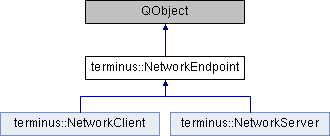
The NetworkEndpoint class provides a common interface that NetworkServer and NetworkClient implement.
More...
#include <networkendpoint.h>
The NetworkEndpoint class provides a common interface that NetworkServer and NetworkClient implement.
It manages an underlying TcpSocket and implements logic to serialize and deserialize AbstractCommands
- See also
- NetworkServer, NetworkClient, AbstractCommand
| Enumerator |
|---|
| Listening |
|
| Connected |
|
| Disconnected |
|
| terminus::NetworkEndpoint::NetworkEndpoint |
( |
QObject * |
parent = 0 | ) |
|
| terminus::NetworkEndpoint::~NetworkEndpoint |
( |
| ) |
|
|
virtual |
| AbstractCommand * terminus::NetworkEndpoint::deserializeCommand |
( |
const QString & |
message | ) |
|
|
protected |
| void terminus::NetworkEndpoint::disconnect |
( |
| ) |
|
disconnect the underlying socket
| void terminus::NetworkEndpoint::onDataReceived |
( |
| ) |
|
|
protectedslot |
| void terminus::NetworkEndpoint::receivedCommand |
( |
AbstractCommand * |
command | ) |
|
|
signal |
serializes command and sends it to the opposite NetworkEndpoint
- Parameters
-
| command | - ownership is not taken |
| void terminus::NetworkEndpoint::sendMessage |
( |
const QString & |
message | ) |
|
|
protected |
| QString terminus::NetworkEndpoint::serializeCommand |
( |
AbstractCommand * |
command | ) |
|
|
protected |
| void terminus::NetworkEndpoint::setSocket |
( |
QTcpSocket * |
socket | ) |
|
|
protected |
| QTcpSocket * terminus::NetworkEndpoint::socket |
( |
| ) |
|
|
protected |
| void terminus::NetworkEndpoint::stateChanged |
( |
State |
newState | ) |
|
|
signal |
| QTcpSocket* terminus::NetworkEndpoint::m_socket |
|
protected |
| State terminus::NetworkEndpoint::m_state |
|
protected |
The documentation for this class was generated from the following files:
 1.8.9.1

